
NEWS
6/11/2026
#HRNOTES 45
EVERANCE PAY EVEN WITHOUT ACTUAL ORGANISATIONAL CHANGES? WHAT MATTERS IS WHAT THE PARTIES AGREED.
The Czech Supreme Court recently addressed the question of whether an employee is entitled to severance pay where their employment was terminated by mutual agreement on organisational grounds that did not actually exist.
The employer had originally intended to terminate the employment relationship due to the employee's serious breaches of work-related duties. Ultimately, however, the parties agreed to terminate the employment relationship on the grounds of redundancy and agreed on severance pay equal to three times the employee's average earnings.
In reality, however, no organisational changes had taken place, and both parties were aware of this. The employer subsequently refused to pay the severance, arguing that the employee had no statutory entitlement to it.
The Supreme Court nevertheless emphasised that an employee's entitlement to severance pay may arise not only by operation of law but also from an agreement with the employer, including in circumstances where the Labour Code does not provide for such an entitlement.
The decisive factor is the parties' genuine intention. If the parties intended to agree on the payment of severance regardless of whether organisational grounds actually existed, the employer is obliged to honour that agreement. This was also the conclusion reached by the Court in the case at hand.
What Does This Mean in Practice?
It is important to distinguish between severance pay to which an employee is entitled directly under the Labour Code and severance pay arising on another legal basis, typically an agreement with the employer or an internal regulation. An employer may undertake to provide severance pay not only in an amount exceeding the statutory minimum but also in circumstances where the employee has no statutory entitlement to severance pay at all.
An employer who assumes that a fictitious reason for termination stated in a termination agreement means that the employee will not be entitled to severance pay may therefore be mistaken. By entering into such an agreement, the employer may establish an independent contractual entitlement to severance pay, regardless of the actual reason for termination.
At the same time, this approach may create complications for the employer in relation to mandatory social security and health insurance contributions. Where there is no statutory ground for severance pay, the amount paid is subject to social security and health insurance contributions payable by both the employee and the employer.
Greater legal certainty for both parties may therefore be achieved by transparently designating such payments as something other than severance pay, for example, as a termination payment, an extraordinary bonus or another form of contractual compensation.
Legal services in CZ, SK and abroad
Contact

info@forlex.cz
+420 596 110 300
Ostrava
FORLEX s.r.o., attorneys-at-law
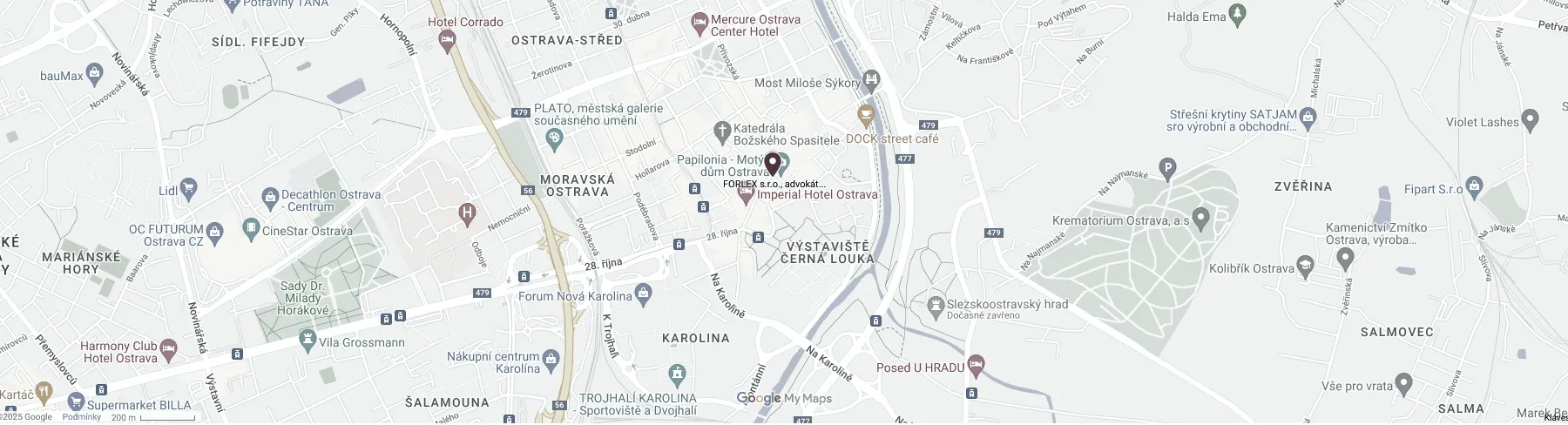
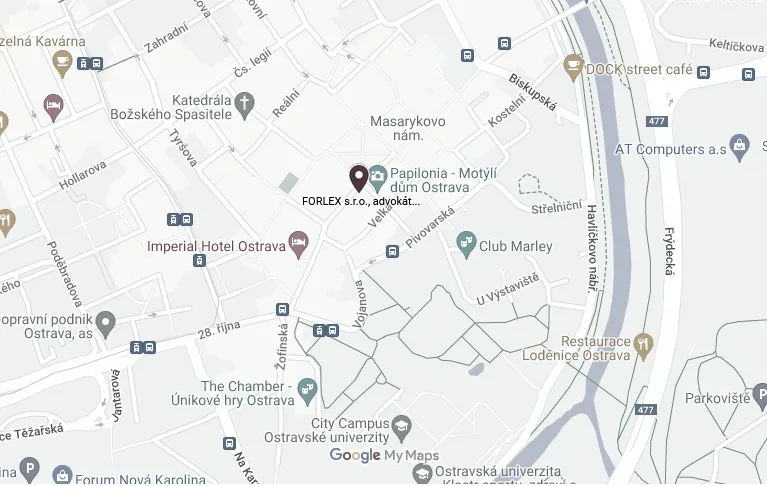
28. října 3159/29, 702 00 Ostrava
Brno
FORLEX s.r.o., attorneys-at-law
Palác Trnitá, Trnitá 542/18, 602 00 Brno
Billing information
IČO: 04275705, DIČ: CZ 04275705
ČSOB
Account No. CZK – 321695472/0300
Account No. EUR – 333568649/0300
Registred in the Commercial Register maintained by the Regional Court in Ostrava, Section C, File 63028.
Consumer protection information
On 5 February 2016, the Czech Bar Association was authorized by the Ministry of Industry and Trade of the Czech Republic to deal with alternative consumer dispute resolutions in the field of disputes between a lawyer and a consumer arising from legal service agreements (under Act no. 634/1992 Sb., on consumer protection, as amended). The website of the designated body is www.cak.cz.